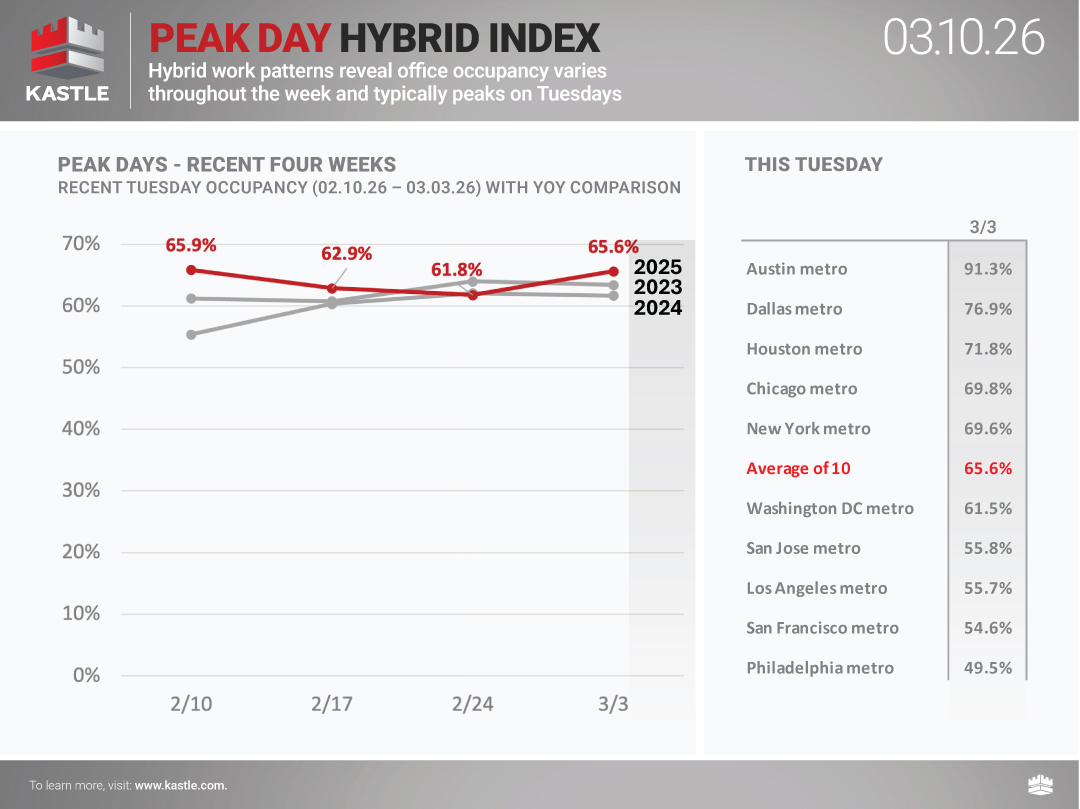
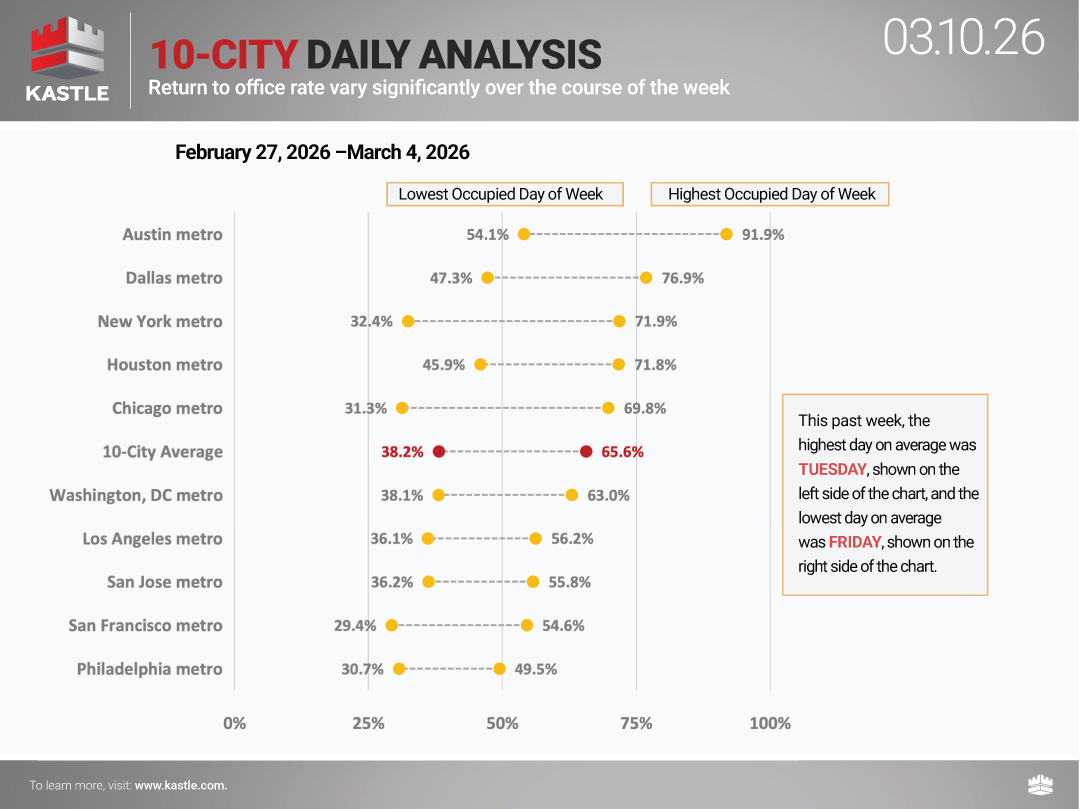
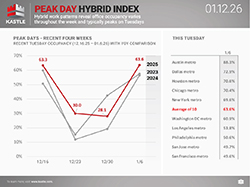
Hybrid work patterns reveal occupancy varies throughout the week with Tuesdays typically being the highest day of the week and Fridays being the lowest. The chart below tracks Tuesday occupancy over time in ten cities and provides a new dimension to the weekly Barometer report. The Peak Day Hybrid Index will now be published weekly, offering a wider aperture into the full picture of workplace occupancy.
Get Weekly UpdatesYou can now track the Return to Work Barometer on the Bloomberg Terminal, available under {ALLX KASL<GO>}
Class A+ Occupancy
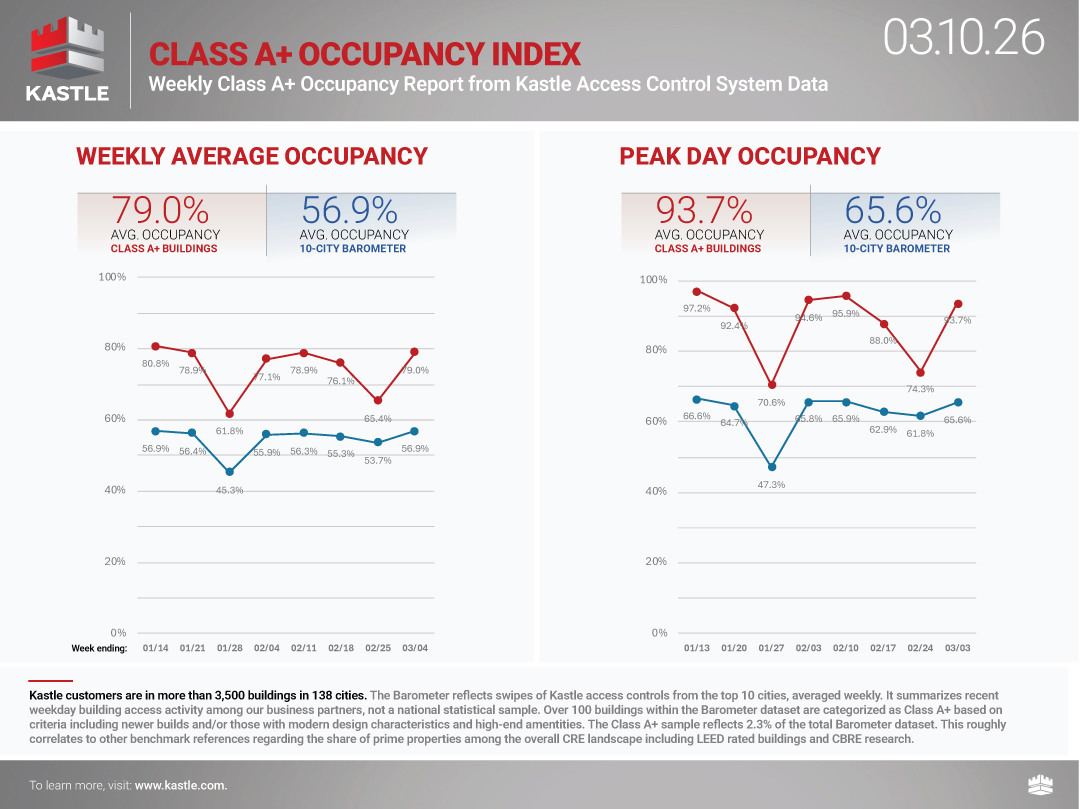
Occupancy leapt up this week as winter weather gave way to clearer skies; workers in A+ class buildings returned to push occupancy for the week to 79.0%, up nearly 14 points form the week prior, and higher than the any week back to January. Occupancy peaked Tuesday, at 97.3%, a rise of nearly 20 points over the Tuesday prior.
Peak Day
Office occupancy surged forward compared to the week prior, when winter weather made travel difficult in several eastern cities. Monday occupancy in New York City rose 49.3 points, to 55.0%. Tuesday occupancy in New York was up nearly 30 points, to 69.6%, and Wednesday rose more than 12 points to hit 71.9% in that city. Philadelphia (up on Monday 33.2 points, to 39.3%) and Washington DC (up Monday 19 points, to 50.6%) saw similar daily occupancy patterns, though with lessor increases. Across the whole 10 City Back to Work Barometer, occupancy was up more than 10 points on Monday (53.4%), up 3.9 points on Tuesday (65.6%), and 8 tenths on Wednesday (65.2%).
Weekly Average
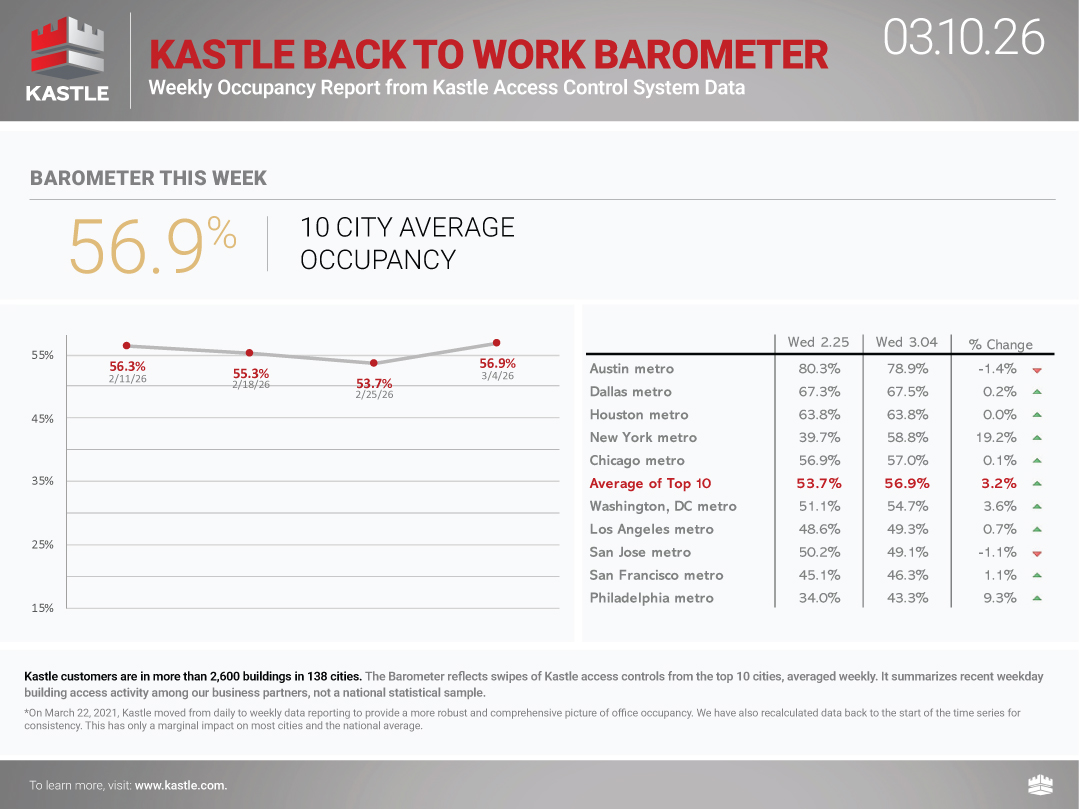
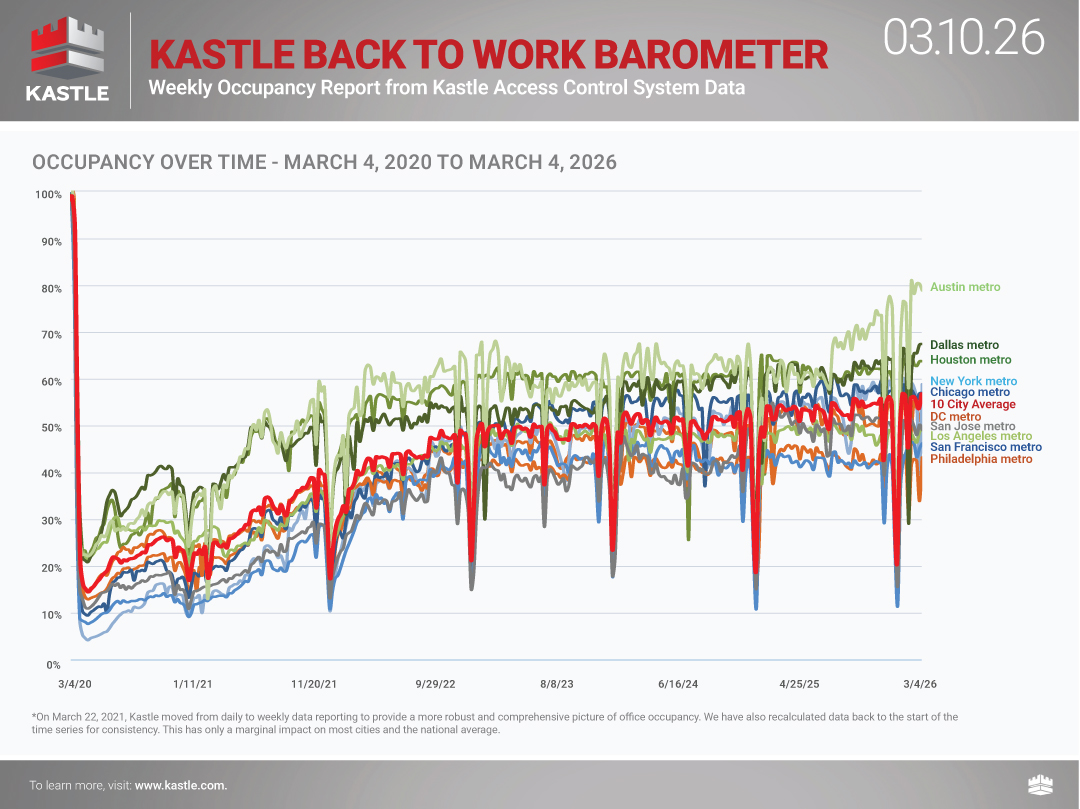
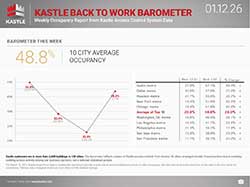
Office occupancy rebounded this past week from the prior week’s winter weather which had impacted several eastern cities; the 10 City Back to Work Barometer rose 3.2 points to 56.9%, matching the record high first set in mid-January. New York (up 19.2 points to 58.8%) Philadelphia (up 9.3 points to 43.3%) and Washington DC (up 3.6 points to 54.7%) experienced the biggest increases, but the return to the office was more broad based, with 8 of ten Barometer cities experiencing at least modest increasing occupancy or holding steady. Dallas TX (67.5%) increased two tenths to reach a record high for the second week in a row.
Methodology
To provide some clarity on the issues facing American businesses, Kastle has been studying keycard, fob and KastlePresence app access data from the 2,600 buildings and 41,000 businesses we secure across 47 states. We’re analyzing the anonymized data to identify trends in how Americans are returning to the office.
We have tracked and published U.S. office occupancy status in Kastle-secured commercial properties since the beginning of the Covid crisis in early 2020. We continue to seek to help companies navigate the ever-changing workplace landscape and adjust to the ‘new normal’ of office occupancy. Whether full-time hybrid or in-person, our commitment remains to helping American businesses understand how average workplaces are being attended weekly, monthly, and annually.
Kastle’s reach of buildings, businesses and cardholders secured generates millions of access events daily as users enter office complexes, and individual company workspaces. The Barometer weekly report summarizes access control data among our business partners in ten major metro areas, not a national statistical sample. Charted percentages reflect unique authorized user entries in each market relative to a pre-COVID baseline, averaged weekly.*
*On March 22, 2021, Kastle moved from daily to weekly data reporting to provide a more robust and comprehensive picture of office occupancy. We have also recalculated data back to the start of the time series for consistency. This has only a marginal impact on most cities and the national average.
Click here for more information about the Barometer methodology and FAQ
Ready to make your property smarter and more secure? Connect with Kastle's experts to find the perfect solution tailored to your needs.


 Workplace Occupancy Barometer
 Legal Occupancy Barometer
 Barometer Data Science