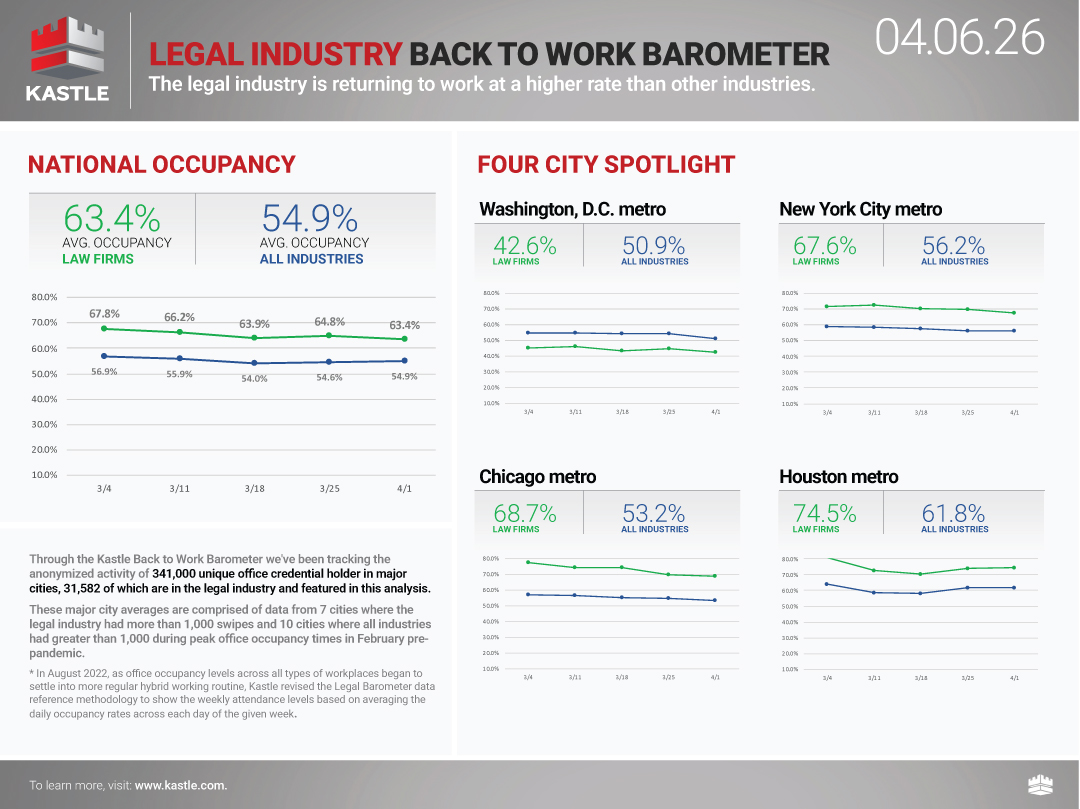
Workers in law firms were slightly more immune to the call of Spring Break last month, compared to their coworkers in other industries. They continued their pattern of higher occupancy over other industries, averaging 73.2% attendance on the three nearly equal peak days of Tuesday/Wednesday/Thursday last month. Comparatively, occupancy was only 62.1% in law firms for the four Mondays in March, and down to 42.3% for the four Fridays,
For the each of the seven cities in the Legal Barometer, occupancy was consistently higher in law firms than for all industries.
Kastle will now publish the Legal Barometer during the first week of each month, and it will include the past four weeks.
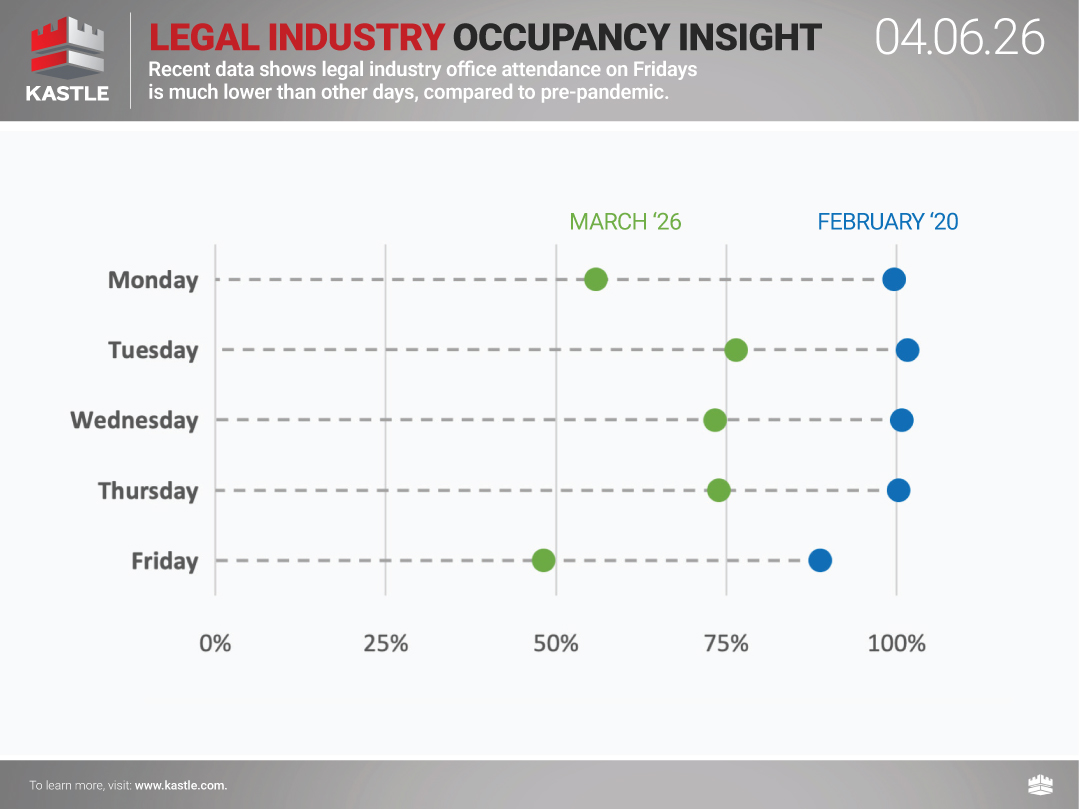
The chart below shows the variability by day for Legal workplace occupancy with the figures reflecting the daily averages for the preceding four weeks, compared to the daily averages pre-pandemic. Note that Mondays and Fridays have much lower office attendance relative to the middle-of-the-week days compared to pre-pandemic.
About Kastle
With extensive depth in the legal industry securing 49 firms of the AmLaw100, Kastle Systems, the country’s largest managed security services provider to commercial businesses, is sharing anonymized aggregated access data from Kastle-secured businesses in the legal industry to better understand office occupancy patterns following COVID-19.
*August 2022 Update to Legal Industry Data Analysis:
Since April 2021, Kastle has provided a weekly analysis of access activity data from businesses in the legal industry in seven markets. Until now, the Legal Occupancy Barometer tracked whether an employee came in any one of five days of the week. This was published along with Kastle’s national data from the ten-city Barometer, which analyzes weekly average attendance for each day of the week.
As office occupancy levels across all types of workplaces began to settle into a more regular hybrid working routine, Kastle revised the Legal Occupancy Barometer to provide a more refined view of occupancy by analyzing the average of access activity data for each day of the week. The enhanced analysis takes into account the new pattern of office work, in which people are more likely to split their time between the office and home. This adjustment allows for richer detail on legal industry occupancy and better aligns the analysis with the ten-city Barometer.
Ready to make your property smarter and more secure? Connect with Kastle's experts to find the perfect solution tailored to your needs.


 Workplace Occupancy Barometer
 Legal Occupancy Barometer