
The call always comes at a bad time.
A camera goes down and someone finally looks at the system closely. Or a compliance review flags the system as a risk. And then comes the conversation nobody planned for: the hardware is old, the software is no longer supported, and the recommendation is to replace it.
Not repair it. Replace it. All of it.
Most businesses treat a security system like a capital purchase: buy it, install it, and move on. What they don’t account for is what happens after, because the system doesn’t stay current on its own, and the cost for ignoring it eventually arrives. It’s just rarely budgeted for.
Your Security System Has a Shelf Life. Nobody Tells You That at Installation.
When a security system is installed, the focus is on what it can do on day one. Nobody talks about what happens years later.
Cameras typically begin to show meaningful degradation within 4 to 6 years.¹ Image quality drops. What was a clear, usable picture in year one becomes blurry, unreliable, or intermittently unavailable. The door readers and the equipment managing your building access generally reach the end of their reliable service life within 5 to 7 years.¹ And the software running those devices stops receiving security updates on a similar timeline, leaving systems increasingly exposed the longer they run.
The majority wait more than five years before upgrading their systems, and the average replacement is closer to 7 years, driven by budget availability.
But wear and age are only part of the story.
The Technology Around Your Security System Keeps Changing
A security system isn’t just equipment on a wall. It runs software and connects to a network. And that technology is always evolving, whether the system gets updated or not.
Vendors release software updates to fix security vulnerabilities, improve performance, and keep the system compatible with everything around it. When those updates aren’t made, the system keeps running, but it’s out of date and increasingly exposed. It becomes a documented entry point for someone looking to get in. The risk quietly stacks up.
Take badge readers for a door as an example. A system that was current at installation is often two or three generations behind by the time anyone looks at it closely. Those same badge readers were not designed to read mobile wallet credentials available today. It means new readers, software, and installations for every door in every office.
When the Reckoning Arrives, It’s Never Just a Repair
Here’s the part that catches most offices off guard. When the reckoning arrives, it doesn’t look like a manageable upgrade. It looks like a full replacement of equipment and software across every office location. None of it budgeted. All of it urgent.
Urgency is expensive. The same principle applies here as it does with any critical system: Replacing an HVAC unit on a planned schedule costs a fraction of what it costs when the unit fails on the hottest day of August. An unplannedsecurity system replacement is the same. Your office is responding to a failure, not a planned decision, and the replacement is priced accordingly.
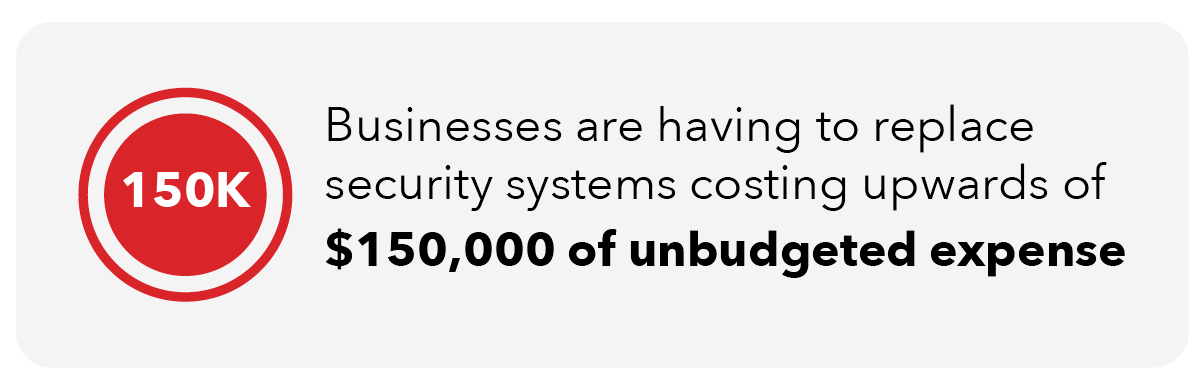
Replacing the cameras, door readers, and the equipment behind them can run as much as $5,000 per door. ² A firm with three offices and ten controlled doors per location is looking at a potential bill of $90,000 to $150,000 on a timeline the equipment sets. None of it budgeted for.
What Planned Looks Like
The alternative isn’t complicated. A managed security provider treats the system as an ongoing responsibility, not a finished product. Instead of responding to a failure, a managed security partner monitors system health continuously, flags equipment approaching end-of-life, and plans upgrades on a schedule. Replacements happen in pieces, at predictable cost, before the system forces the issue.
Independent lifecycle research puts the total cost difference between managed and reactive approaches in the millions of dollars over ten years for business with multiple offices. ³ Not because managed security is a discount, because emergency replacement is expensive.
Want to learn more? If nobody has reviewed your system recently, the clock is running. See what an aging, unmanaged security system is costing your firm.
Next: Blog 4 — Your Security System Might Be Your Biggest Cybersecurity Risk. An outdated security system isn’t just a physical security problem. It’s a documented entry point into your IT network, and the risk compounds with every skipped update.
Sources
¹ Understanding the Lifecycle of Security System Equipment, Access Professionals, August 15, 2023
² Understanding the Hidden Costs of Physical Access Control: A Comparative Lifecycle Analysis, Memoori / Kastle Systems, 2025