
Mobile surveillance remote monitoring: Why the camera is only half the story
Get your free construction security guide
Six layers, two site audits, and the gaps a moving site creates.





When someone empties a construction site's equipment trailer over a long weekend or siphons fuel from an unstaffed utility yard before dawn, the mobile surveillance unit captures it all in clear, time-stamped footage. But if the site is unmonitored, nobody sees the footage until the next workday, when the equipment is already gone.
A camera that no one is watching is only a documentation tool. It gives you a record to hand to an insurer, not a way to stop the theft. With mobile surveillance remote monitoring, trained agents watch the feed live and can step in while the theft is still in progress. That is what a mobile video surveillance monitoring service provides: live agents on every unit. For a site with no one on the ground at night, live monitoring is what separates a recorded incident from a prevented one.
Remote access vs. remote monitoring: What's the difference?
Remote access is a camera with a login. An authorized user opens an app or browser and looks at the live feed when they choose. The value depends entirely on someone deciding to check at the right moment. It is likely that no one is watching overnight, on weekends, or during shift changes.
Remote monitoring for mobile surveillance is a managed service. Trained agents watch camera feeds in real time from a monitoring center. AI-assisted detection flags unusual activity for agents to review. When an agent confirms a threat, a defined response protocol begins. The response could be a verbal warning over the unit's two-way audio, a call to law enforcement, or an alert to on-site personnel, and it happens well before the property manager's phone rings.
For a site with no overnight staff, that operational difference is the entire security value.
| Remote access | Remote monitoring | |
|---|---|---|
| Who is watching | An authorized user, when they log in | Trained agents in a monitoring center, around the clock |
| Coverage | Only when someone checks | 24/7, including after hours |
| On detection | A user has to notice and act | AI flags the event, an agent verifies, a response protocol begins |
| Security role | Documentation after the fact | Deterrence and interruption in real time |
-
Who is watching
Remote access
An authorized user, when they log in
Remote monitoring
Trained agents in a monitoring center, around the clock
-
Coverage
Remote access
Only when someone checks
Remote monitoring
24/7, including after hours
-
On detection
Remote access
A user has to notice and act
Remote monitoring
AI flags the event, an agent verifies, a response protocol begins
-
Security role
Remote access
Documentation after the fact
Remote monitoring
Deterrence and interruption in real time
How does mobile surveillance remote monitoring work?
Live monitoring is a continuous loop of detection, human verification, and response, applied to every deployed unit.
The model works in a sequence:
- AI-assisted detection scans each feed and flags motion or activity that fits a threat pattern, filtering out routine movement.
- A trained agent reviews the flagged event in real time and confirms whether it is a threat or a false alarm.
- For a confirmed threat, the agent uses two-way audio to issue a live warning. An intruder who hears a specific, human callout often leaves.
- If the warning does not resolve it, the agent follows a defined response protocol. That can include notifying law enforcement, dispatching on-site personnel, or escalating according to the site's plan.
- Every action is recorded in an incident report, including footage, timestamps, and the agent’s steps.
The value is evident after hours. A construction site at 2 a.m. has no crew and no foot traffic, so any movement is worth questioning. That is when 24/7 mobile surveillance monitoring matters most. Passive recording captures that moment the same way it captures midday foot traffic. But live monitoring is set up to act on it, because an empty site with movement on camera is precisely the pattern agents are watching for.
The model also scales in a way an in-house approach cannot match. One monitoring center watches mobile units across dozens of sites at once. The same team covers a regional portfolio of construction yards, parking lots, and remote facilities, under the same protocols, with no staff at any location. For a site owner running remote video monitoring across mobile units in several states, that consolidation keeps coverage consistent.
What does AI detection do in mobile surveillance monitoring?
AI does not replace the monitoring agent. It allows one monitoring agent to watch many feeds by flagging what deserves a human's attention.
No monitoring team can stare at dozens of live feeds without missing things. AI-assisted detection makes live monitoring of many mobile surveillance units viable by screening feeds first, so agents focus on the events that need their attention.
- Motion filtering separates meaningful movement from environmental noise such as wind, rain, headlights, and wildlife, so agents are not flooded with false alerts.
- Object classification distinguishes a person from a vehicle or an animal, so a raccoon does not trigger the same response as someone climbing a fence.
- Behavioral analytics flags the patterns that matter on an empty site, such as loitering near a gate or a perimeter breach.
- Multi-factor confirmation combines signals before flagging an event, reducing false alarms and keeping agents focused on real threats.
The point is scale. AI decides which moments are worth a person's attention, and the agent decides how to respond. Mobile surveillance AI monitoring without a human behind it is just recording with extra steps. Software alone cannot talk an intruder off a site or make the judgment call to involve the police.
Which sites need live monitoring most?
Live monitoring changes outcomes most on unstaffed, temporary, or spread-out sites, where no one is watching a recorded feed.
Mobile surveillance monitoring for construction sites
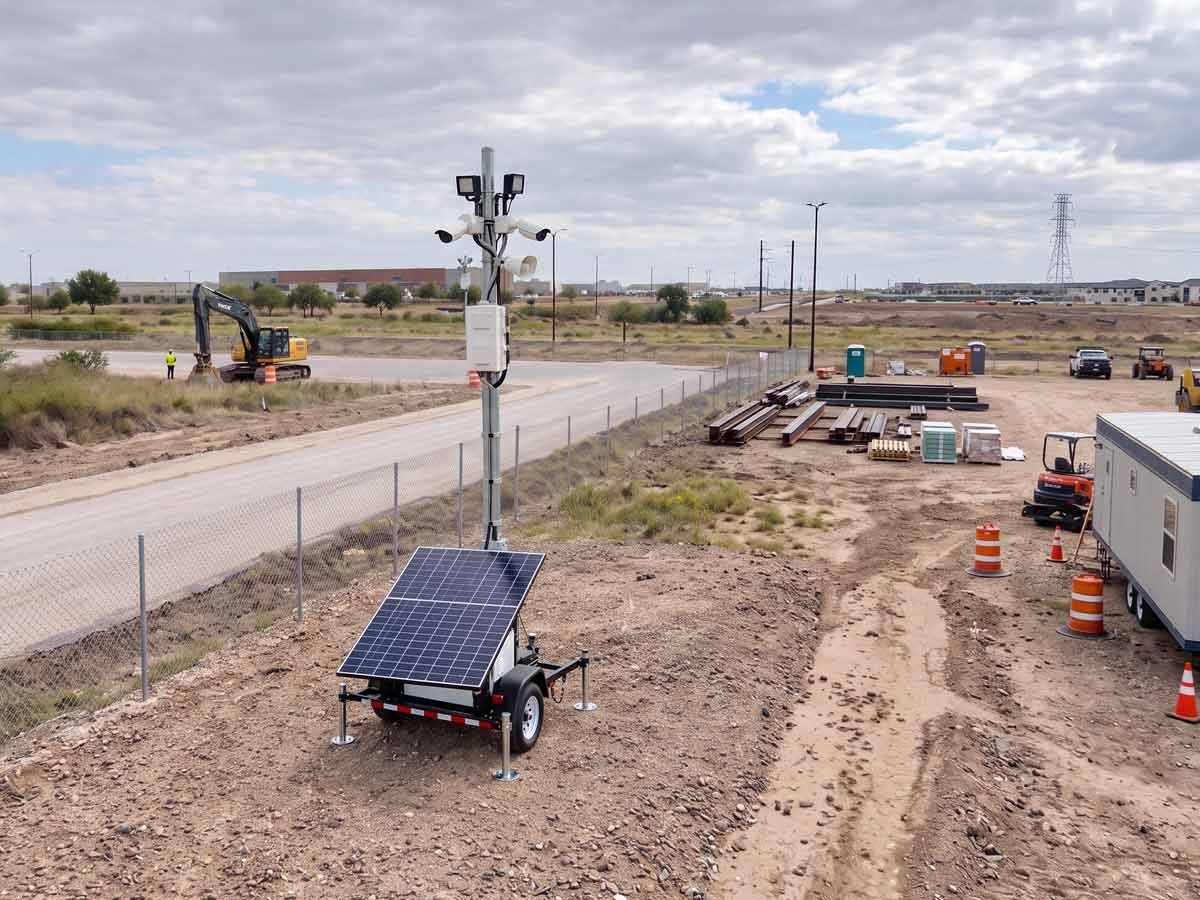
Equipment, materials, copper, and fuel are stolen from sites that are empty at night and on weekends. When a break-in is only recorded, the site owner has to file an insurance claim the next morning. When it is monitored live, an agent can issue a warning and call law enforcement while the intruder is still on site.
Mobile surveillance monitoring for parking lots
After-hours vehicle break-ins and catalytic converter theft happen quickly, often in minutes. Cameras that only record capture a license plate for a report. Live agents with two-way audio can interrupt the theft as it happens and dispatch police on your behalf.
Utility and infrastructure sites
These sites are remote and unstaffed, and they hold high-value assets, so distance is the vulnerability. No one is nearby to respond, so the time between an incident and any reaction is significantly longer. Remote monitoring reduces that exposure by placing a trained agent on the site's feed around the clock.
Events and temporary gatherings
Crowds are dynamic, and situations change by the minute. Real-time monitoring gives organizers situational awareness as incidents unfold. With mobile surveillance monitoring for events, the right person is alerted so they can respond promptly to issues such as a flagged crowd surge or an access breach.
Retail and commercial properties
Seasonal traffic, parking-lot expansion, and thin overnight staffing create coverage gaps that vary through the year. Deployable monitored units can cover a parking lot through the holidays or construction without a permanent installation. This approach helps match coverage to the level of risk.
What to look for in a mobile surveillance monitoring service
The questions below will help you separate a real mobile video surveillance monitoring service from a camera with a login. Ask every vendor the following:
- Who staffs the monitoring center? Find out whether agents are dedicated or spread thin across too many accounts, and whether the center operates 24/7 or only flags events for later review.
- What is the response-time commitment? A monitoring service should specify the timeframe for notifying a live agent of a flagged event, preferably in a written Service Level Agreement (SLA).
- How specific is the response protocol? There is a real difference between a defined escalation path for each site and general agent discretion. Ask to see the protocol.
- What can the AI detection catch, and what does it miss? Ask what the system classifies, how it handles environmental false alarms, and at what point a human takes over.
- Can one service monitor multiple sites at once? For a portfolio, confirm that a single center manages every mobile unit across locations under one platform.
- Does monitoring integrate with your other systems? Ask whether it connects to access control, alarm systems, and incident management.
- What does the documentation look like after an incident? A monitoring service should produce a full incident record with footage, timestamps, and actions taken, ready for insurance or law enforcement.
Monitored mobile surveillance vs. on-site guards: Which one makes sense?
A guard covers one location and one line of sight at a time, cannot maintain full attention over a long shift, and cannot see past the property line. A monitored mobile unit covers multiple angles continuously, and a monitoring center covers many sites at once without adding staff at each one. Across an after-hours, multi-site portfolio, monitoring can stretch a security budget by letting guards focus their presence in key on-site areas.
A guard can physically intervene, escort someone, respond to a medical situation, and evaluate a situation in ways software and a remote agent cannot. On a single high-traffic site that needs a physical presence, a guard is often the right answer.
Monitored mobile surveillance is not a universal replacement for guards. It can extend perimeter, after-hours, and distributed coverage, and the two are often used together.
| Factor | On-site guard | Monitored mobile surveillance |
|---|---|---|
| Coverage area | One location, one sightline at a time | Multiple angles per unit, many sites from one center |
| Consistency | Varies over a long shift | Continuous, same protocol every hour |
| Cost basis | Per guard, per site, per shift | All-inclusive monthly fee |
| Physical response | Can intervene directly on site | Remote deterrence, then law enforcement or on-site dispatch |
| Documentation | Manual reports | Automatic incident record with footage |
-
Coverage area
On-site guard
One location, one sightline at a time
Monitored mobile surveillance
Multiple angles per unit, many sites from one center
-
Consistency
On-site guard
Varies over a long shift
Monitored mobile surveillance
Continuous, same protocol every hour
-
Cost basis
On-site guard
Per guard, per site, per shift
Monitored mobile surveillance
All-inclusive monthly fee
-
Physical response
On-site guard
Can intervene directly on site
Monitored mobile surveillance
Remote deterrence, then law enforcement or on-site dispatch
-
Documentation
On-site guard
Manual reports
Monitored mobile surveillance
Automatic incident record with footage
How a managed security service covers the monitoring gap
Closing the distance between recording an incident and responding to one requires a managed service. One provider should own detection, monitoring, response, and documentation for every unit.
A managed mobile surveillance service puts the entire loop under one accountable provider. Trained agents, AI-assisted detection, two-way audio, defined response protocols, and incident documentation operate as one service.
Kastle's mobile surveillance monitoring is a managed physical security service. The same monitoring operations and protocols that protect thousands of commercial properties also cover every deployed mobile unit, so the response capability does not change when a camera is on a security trailer instead of a building.
Kastle has operated this managed model for over 50 years, protecting more than 60,000 businesses across the United States and Australia. That means you have one accountable partner for the entire security lifecycle, from design and installation through monitoring and maintenance, with a single team responsible for the outcome.
Frequently asked questions
Remote access lets an authorized user log in and view a camera feed when they choose to look. Remote monitoring is a managed service where trained agents watch feeds in real time. AI flags unusual activity, and an agent responds as soon as they confirm a threat.
In a live monitoring service, AI flags an event and a trained agent reviews it within seconds. Response time depends on the provider's staffing and its written SLA, so ask for that commitment in writing. A serious monitoring service will state a specific response time.
The cost depends on the number of units, how many hours of monitoring you need, the response protocols involved, and how many sites are covered. Because those factors vary widely, monitoring is priced based on the setup. Talk to our team about your sites for an accurate estimate.
Yes. A single monitoring center can watch mobile units across many sites at once, under one platform and one set of protocols. This is a core advantage of managed monitoring over local, site-by-site arrangements.
Every confirmed event creates an incident record that includes the footage, timestamps, and the agent’s actions. That documentation supports insurance claims, law enforcement reports, and internal review. Ask any provider what their incident report contains before you sign.
Tell us about your project and our team will follow up.